
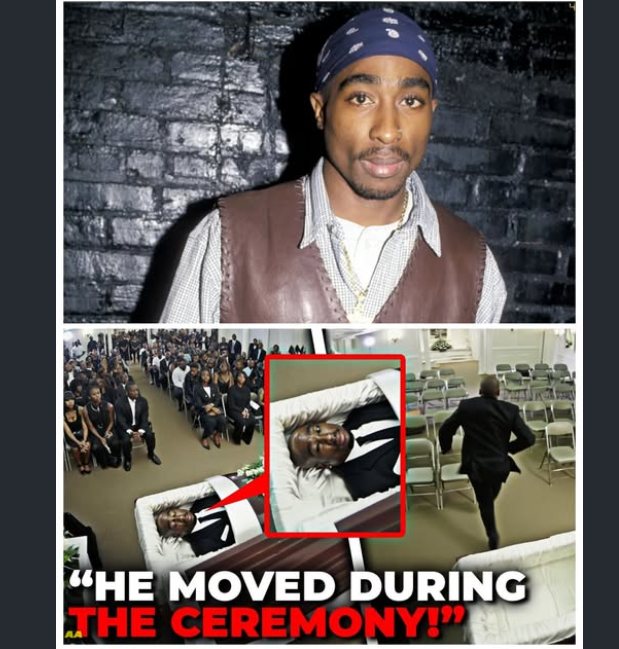
In 2025, nearly thirty years after Tupac Shakur’s tragic death, the music world was shaken by the resurfacing of grainy footage that appeared to show the rapper’s body at a funeral viewing.
The brief clip, lasting only fourteen seconds, immediately sparked debate across the internet, challenging long-held beliefs about the circumstances surrounding his passing.
The footage is low light, filmed at an angle suggesting secrecy, and shows a body surrounded by candles and a handful of mourners.
If authentic, it directly contradicts the official timeline that the public has accepted for decades, which stated that Tupac was cremated privately on a Malibu beach without any public viewing or open casket presentation.Tupac Amaru Shakur, renowned poet, revolutionary, and influential performer, was shot on September seventh, nineteen ninety-six, in a drive-by incident in Las Vegas.
He had attended the Mike Tyson boxing match at the MGM Grand with Suge Knight.
The plan was simple: celebrate, show public presence, and return to Los Angeles.
Moments after the fight, however, a white Cadillac pulled up beside Tupac’s BMW at a red light on Flamingo and Koval Lane.
Thirteen rounds of gunfire were exchanged.
Four bullets struck Tupac, hitting his chest, arm, and thigh.
Suge Knight was grazed during the attack.
By eleven twenty p.m., Tupac was rushed to the University Medical Center in critical condition.
Despite the efforts of medical personnel, he would not survive.
Close friends and collaborators were among the first to arrive at the hospital, including filmmaker Gobi Raheem, who had directed Tupac’s music videos and helped shape the visual identity of the rapper’s career.
Raheem described the chaotic scene at the University Medical Center, noting the absence of press and law enforcement, replaced by a tense silence.
He observed Suge Knight’s parents, Tupac’s fiancée, and other close associates waiting anxiously for updates from medical staff.
The nurse who first approached the group reported the severity of Tupac’s injuries.
His right lung had been shot out, requiring immediate removal, and he faced a series of reconstructive surgeries.
Over the next twelve hours, his vitals fluctuated as medical staff worked to repair damage and stabilize his condition.
Throughout the following nights, Tupac’s inner circle maintained a vigilant presence at the hospital, guarding entrances, coordinating security, and rotating shifts.
According to Raheem, unmarked cars and unfamiliar individuals appeared at the hospital, creating an environment of fear and suspicion.
By the fifth night, the Fruit of Islam, the paramilitary wing of the Nation of Islam, assumed control of security, reflecting the perceived dangers surrounding Tupac and the potential for further violence.
On September thirteenth, nineteen ninety-six, at precisely four oh three p.m., Tupac Shakur was pronounced dead.
His body was cremated the following day at the request of his mother, Afeni Shakur.
The cremation took place privately, and his ashes were scattered into the Pacific Ocean during a small gathering on a Malibu beach.According to family members and Death Row insiders, there was no public viewing, no open casket, and no traditional funeral service.
Afeni Shakur intended to protect her son from posthumous exploitation and to preserve his dignity.
The resurfaced footage, however, casts doubt on this narrative.
Experts analyzing the video noted that the setting resembled mortuary arrangements common in Los Angeles during the 1990s, with candles, cloth coverings, and a small group of mourners.
The body depicted bears tattoos and facial features consistent with Tupac’s known markings.
Yet, the condition of the chest and other surgical areas appears inconsistent with official autopsy reports.
These discrepancies suggest that the body may have been cosmetically reconstructed for viewing, raising questions about whether a private viewing actually took place before the cremation.
For decades, fans believed Tupac’s story ended with the Malibu memorial.
The private gathering included Afeni Shakur, members of the Outlaws, and close friends such as Jada Pinkett Smith and Snoop Dogg.
Rituals were performed to honor Tupac’s legacy, including smoking ashes mixed with marijuana, an act later admitted by Outlaw members.
These gestures, while controversial, were framed as a tribute to Tupac’s wishes and lyrical references.
Some family members disputed these actions, considering them unauthorized and disrespectful.
The newly surfaced footage challenges the chronology of these events, as it appears to show the body in a mortuary on the same day the cremation supposedly occurred.
The day of the shooting remains one of the most dissected events in hip hop history.
Tupac’s morning began in his suite at the Luxor Hotel, accompanied by his fiancée, Kadata Jones.
They prepared for the Tyson fight, which was scheduled for the evening, and Tupac conducted phone calls and routine preparations, maintaining his usual pre-performance rituals.
Tensions with Death Row Records had escalated, and Tupac had recently terminated legal representation, leaving him without official protection from external threats.
Bodyguards assigned by the label were loyal to Suge Knight rather than to Tupac himself.
The brawl at the MGM Grand following the Tyson fight set the stage for the fatal drive-by.
Tupac confronted Orlando Anderson, a known member of the Compton Crips, after a previous altercation involving a stolen medallion.
The confrontation escalated quickly and was caught on casino surveillance.
Although no immediate arrests were made, the altercation heightened existing tensions and created the conditions for retaliation.
Tupac and Suge Knight departed the Luxor Hotel, with Tupac changing clothes and preparing for an afterparty at Club 662.
